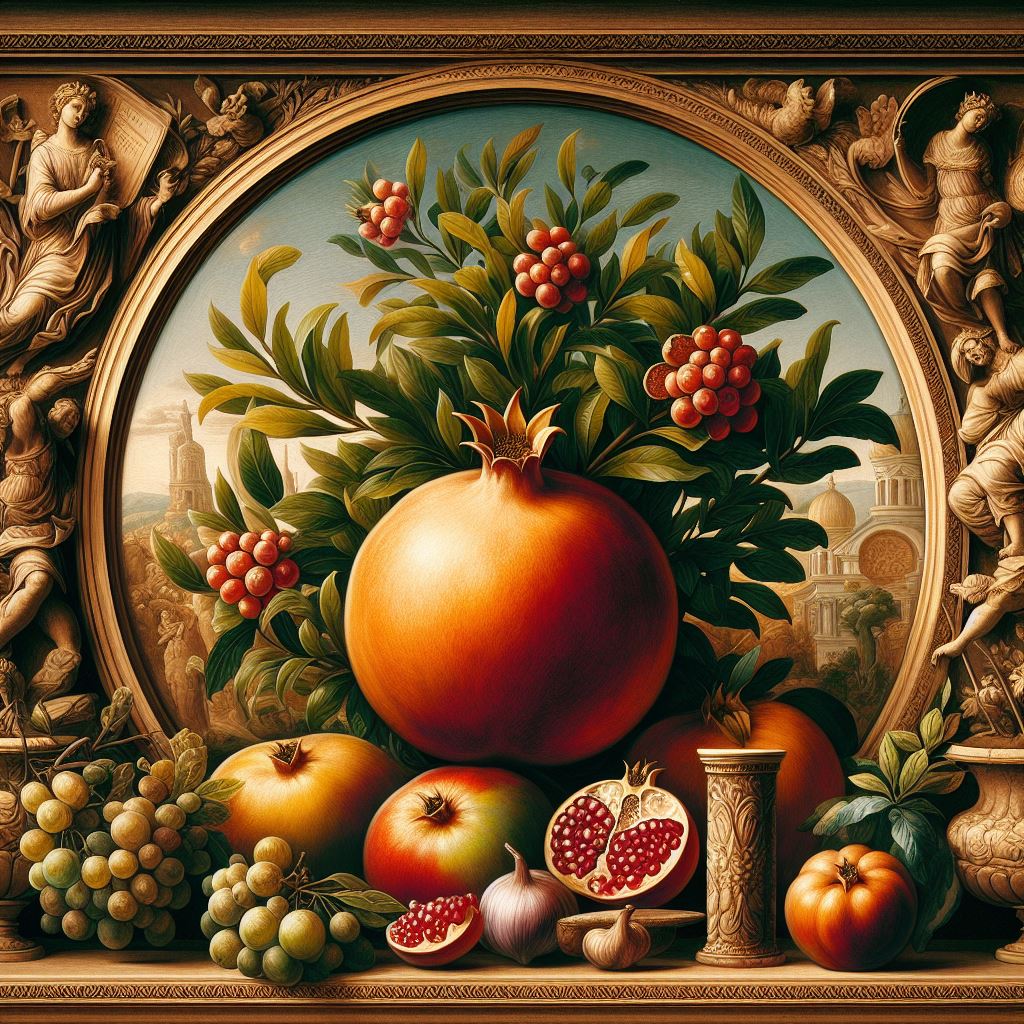
1) Symbol Spotlight
Welcome to our inaugural Symbol Spotlight on Fangs and Fables! Today, we embark on an enchanting journey into the enigmatic pomegranate: a symbol of power and passion throughout various myths and legends.
Pomegranates have long been revered for their rich symbolism and cultural significance. Originating from the Mediterranean region, the pomegranate is a fruit known for its abundance of seeds encased in a vibrant, ruby-red husk. Throughout history, it has been celebrated in various cultures and mythologies for its multifaceted symbolism. Its tough outer skin, which protects the lush seeds within, serves as a metaphor for hidden potential and the nurturing of life. This unique combination of beauty, abundance, and protection has made the pomegranate an enduring symbol across time and cultures.
2) Symbolic Themes
The pomegranate is commonly associated with themes of fertility, death, and rebirth. In ancient mythology, its seeds were often seen as symbols of fertility and prosperity, while its juicy interior represented the cycle of life and regeneration. Across different cultures, the pomegranate has been depicted as a potent symbol of abundance, vitality, and the cyclical nature of existence. In modern times, these themes still resonate, with the fruit continuing to symbolise the intricate balance between life and death, abundance and scarcity, and protection and exposure.
In contemporary symbolism, the pomegranate also embodies complex human emotions, such as passion and desire, thanks to its vivid red colour and the intensity of its appearance. It continues to serve as a representation of life’s hidden depths and the potential for growth and renewal, even when faced with obstacles or adversity.

3) Mythological Examples
Greek Mythology:
In Greek mythology, the story of Persephone and Hades stands as one of the most famous examples of pomegranate symbolism. Persephone, the daughter of the harvest goddess Demeter, was abducted by Hades, the god of the underworld, to become his queen. During her time in the underworld, she ate pomegranate seeds, which bound her to Hades and the underworld. As a result, she had to spend part of each year in the underworld, symbolising the changing seasons—particularly the barrenness of winter when she was with Hades, and the fertility of spring when she returned to the surface.
Canaanite Mythology:
In Canaanite mythology, the pomegranate held profound significance, particularly in the context of funerary rituals and beliefs about the afterlife. Revered as a symbol of fertility, abundance, and the cycle of life and death, the fruit was often included in funeral rites as a sacred offering to the deceased, symbolising the hope for regeneration and renewal in the afterlife. Canaanites believed that the pomegranate possessed mystical properties, imbued with the power to facilitate the transition from earthly existence to the realm of the dead. Just as the pomegranate’s seeds contain the potential for new growth, so too did the Canaanites envision the soul’s journey through death as a process of transformation and renewal.
Jewish Tradition:
In Jewish tradition, the pomegranate is a symbol of righteousness, fruitfulness, and wisdom. It is also celebrated for its abundant seeds, which are believed to symbolise fertility and prosperity. Folklore suggests that the pomegranate contains precisely 613 seeds, a number that holds profound significance within Jewish theology. This figure aligns with the 613 commandments, or mitzvot, outlined in the Torah, the sacred text of Judaism. Each seed thus symbolically corresponds to a specific commandment, reinforcing the idea that the pomegranate serves as a tangible reminder of Jewish religious teachings and ethical principles.
Persian Mythology:
In Persian mythology, the pomegranate symbolises eternal life and fertility. It is often depicted in art and literature as a sacred fruit with mystical properties. Persian poets and artists have used the pomegranate to convey the dualities of life, from love and beauty to death and immortality.
Modern Media:
Beyond ancient myth, the pomegranate has maintained its symbolic presence in modern literature and media. It appears in Salman Rushdie’s ‘Midnight’s Children’, where it symbolises memory and the passing of time, and in popular culture, such as in ‘The Handmaid’s Tale’, where it is associated with themes of fertility and control.

5) Symbolic Interpretation
The symbolic interpretation of the pomegranate revolves around its rich visual and metaphorical qualities. Its abundance of seeds symbolises fertility, while its vibrant red colour evokes passion and vitality. Additionally, the pomegranate’s seasonal harvest cycle serves as a reminder of life’s cyclical nature, with each seed representing the potential for growth and renewal.
On a deeper level, the pomegranate symbolises hidden potential and the nurturing of that potential. Its tough outer skin, protecting the seeds within, reflects the idea that life’s greatest treasures often lie beneath the surface, waiting to be unlocked. This idea resonates psychologically and spiritually, as humans often guard their most precious abilities or emotions, waiting for the right conditions to allow them to flourish.
Symbols like the pomegranate resonate deeply because they reflect our relationship with nature and the cycles of existence. The abundance of seeds offers a visual metaphor for the infinite possibilities within each person’s life, while the fruit’s hidden interior mirrors our psychological depth and potential for transformation.
6) Food for Thought
As we reflect on the symbolism of the pomegranate, we are invited to consider its significance in our own lives. How does this ancient symbol resonate with our modern-day experiences of fertility, life, and regeneration? What personal meanings do we attach to the pomegranate, and how does it inspire us to embrace the cycles of growth and transformation?
Beyond the pomegranate, what other natural symbols evoke themes of regeneration and transformation for you? Whether it’s a plant, animal, or another aspect of nature, what meanings do you attach to these symbols in your own personal narrative?
Share your thoughts and reflections in the comments below.

 Home
Home 
Leave a comment